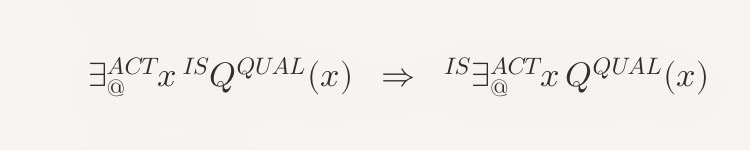
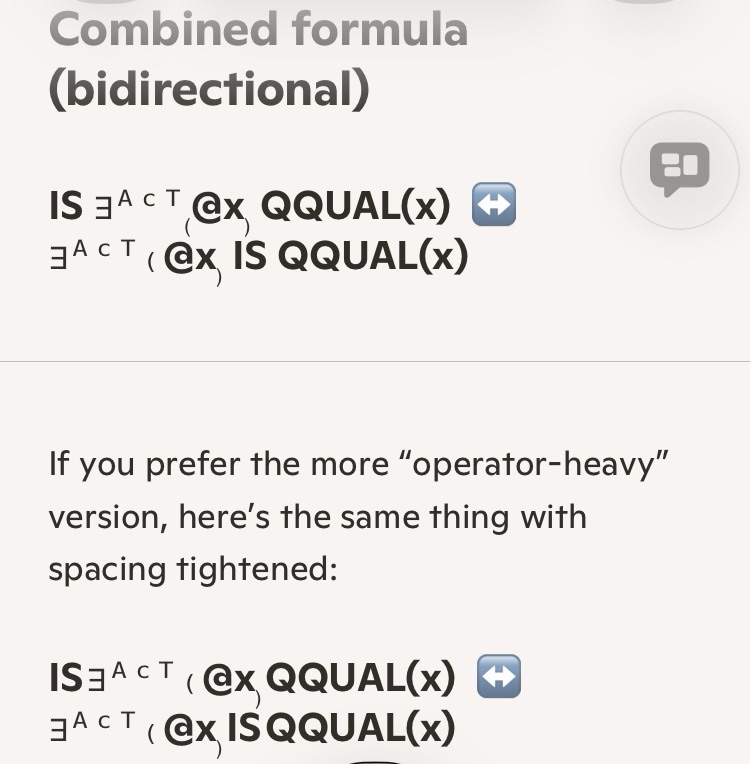
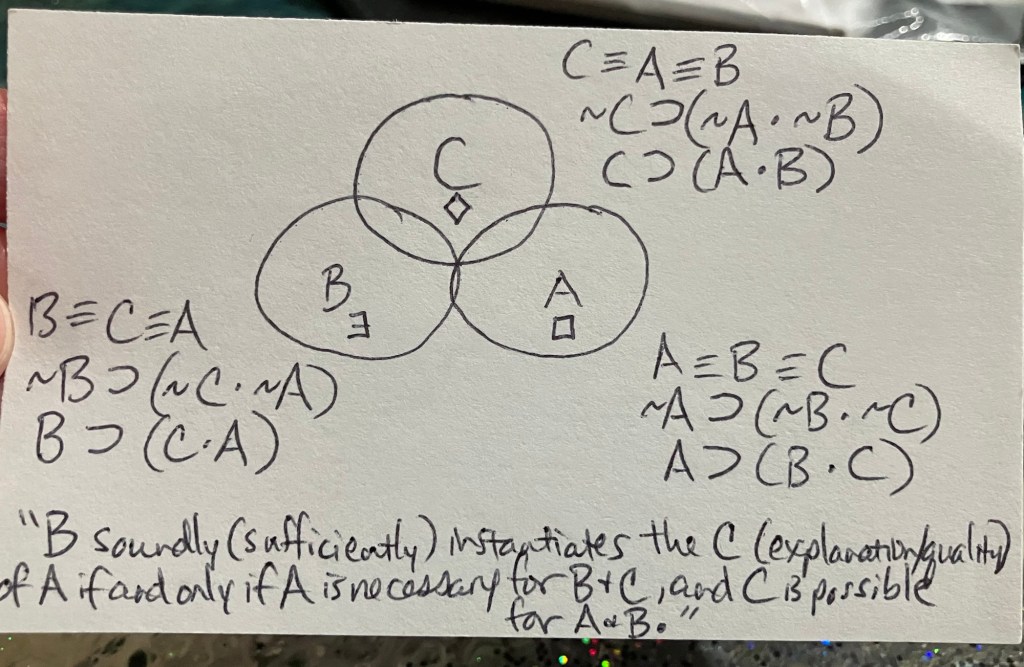
Articulated with the immeasurably helpful assistance of Copilot (read discussion). See Aquinas as an example (including AQUINAS VS. WILLIAM LANE CRAIG ON DIVINE SIMPLICITY).
UNITY‑IN‑DISTINCTION AS A METAPHYSICAL LOGIC
Being △ Action △ Quality as a Unified, Irreducible, Mutually‑Implicating Structure
I. Overview
Unity‑in‑distinction names the structural condition in which Being, Action, and Quality are:
- unified in substance without modal collapse: The triad is one reality, not three substances, and each member of the triad cannot be reduced or collapsed into another member.
- irreducibly distinct in operation without fracture: Each member of the triad has a unique causal-modal function that is real and not symbolic, and never becomes separation.
- mutually entailing without hierarchy or fusion: The triad is incomplete without all three mutually requiring members. None is independent to or alone from the others, none dominates the others, none fuses the others.
This is not a merely formal logical schema. It is a metaphysically necessary structure: the minimal set of relations that must obtain for anything to exist, act, or be meaningful.
II. The Triadic Ontology (Definitions)
The Three Axioms
1. Substantial Import: Being (what it is)
Operational Definition:
“What it is”—substance, identity, temporal persistence, and ontological grounding.
Role:
Gives substance to Action and Quality, and also is influenced by them. Substantial Import is the necessary condition for possible and maximal quality/function, and demonstrative and efficient action. It is the something in “Why is there something rather than nothing?”
Axiom:
Substantial import is the irreducible condition for intelligible existence: without a what, there is nothing to act or matter.
2. Active Import: Action (how it acts)
Operational Definition:
“How it acts”—expression, actualization, process, enactment.
Role:
Gives expression to Being and Quality, and also is influenced by them. Active Import is the irreducible condition for intelligible becoming and the demonstration of being: it is the modal ground of change, process, and enactment. It is how we move toward the answer to, “Is change an illusion?” or “Can people change?”
Axiom:
Active Import is the irreducible condition for intelligible becoming and the demonstration of being: without a how, nothing can change, express itself, or be encountered as dynamic.
3. Qualitative Import: Quality (why it matters)
Operational Definition:
“Why it matters”—form‑of‑life, essential property, meaning, telos (purpose).
Role:
Gives meaning to Being and Action, and also is influenced by them. Qualitative Import is the irreducible condition for intelligible significance: it is the modal ground of value, purpose, and meaning. It is the dimension we hunger for when we ask, “What is the meaning of life?”
Axiom:
Qualitative Import is the irreducible condition for intelligible significance: without a why, nothing would act, and being would be bare of any discernible qualities.
III. Why Three is Fundamental
Three is the minimal number of irreducible distinctions required for anything to be intelligible as a whole rather than a blur, a mere binary pair, or a sequence. With fewer or greater than three fundamental distinctions, intelligibility either reduces into monism or dualism, or explodes into pluralism. With only one distinction, you get undifferentiated monism — nothing can be contrasted, related, or evaluated. With two distinctions, you get dualism — opposition without mediation, tension without resolution, and no way to explain how the two relate or why either matters. Any distinction higher than three (pluralism) is either a redundancy (a sub‑distinction inside one of the three) or a fracture (a mistaken splitting of one distinction into many). Only with three do you get a complete modal structure: one distinction that identifies what something is (Being), one that identifies how it acts or becomes (Action), and one that identifies why it matters or its telos/purpose (Quality). These three are irreducible because each answers a different question — what, how, and why — and none can be derived from the others or take their place without committing a collapse, an explosion, or an illicit inference (mis-modal derivation). Thus three is not an arbitrary count but the irreducibly fundamental architecture of intelligibility itself. Unity‑in‑distinction requires exactly one unity of exactly three distinctions — Being, Action, and Quality — the irreducible structure needed for anything to be intelligible as a whole: the what, the how, and the why. No less, no more.
IV. Triadic First Principles (Three Impossibilities)
A first principle is a premise-less syllogism valid if and only if it is impossible for its conclusion to be false. For example: All A is A (1, 2). There is no such thing as only one first principle, because that would result in being alone, acting alone, and/or meaning alone, each of which is an impossibility that collapses even if taken with just one of the others. The grand syllogism is premise-less and triadic.
There are three impossibilities, the opposites of which are the three first principles which are restatements of the triadic first principle:
The first impossibility is being alone.
Principle: Being alone cannot move or have a reason (why) to be.
The second impossibility is acting alone.
Principle: Action alone has no substance or reason (why) to move.
The third impossibility is meaning alone.
Principle: Reason (why) alone has no substance or action to inform.
Triadic first principle:
Being is substance with Action that moves with sustaining Reason (why).
- Introduction to Logic, Harry J. Gensler, Routledge, 2002 (a 2005 reprint), p. 10.
- Copilot’s take: Examples of First Principles
V. Fallacies of Misrecognition, or Mis-Modal Derivations: Reductions (Fusions), or Single-Arrow Primitives and Double-Arrow Monisms and Dualisms, and Explosions (Fissions), or Many-Arrows (Pluralism)
These logical fallacies are all mis-modal derivations—configurations that do not instantiate without dysfunction. Every fallacy in this paper is a violation of unity‑in‑distinction: either a reduction (fusion), or an explosion (fission). Mis‑modal derivation is the fallacy of inferring one modal role from another—treating Being, Action, or Quality as if one or more of them [or new one(s)] could be derived from (or without) the other/s (take the other/s’ place), rather than just these three distinctions mutually implying each other and their unity.
Reductions (Fusions), or Single-Arrow Primitives and Double-Arrow Monisms and Dualisms
Reductions occur when one modal role attempts to perform the function of another, violating distinctions or fabricating false ones, and sometimes collapsing legitimate distinctions into a compensatory monism or dualism. Monism and dualism are fusion fallacies. In monism, one pole absorbs the other two, whereas in dualism, two poles absorb the remaining pole.
1. Single-Arrow Mis-modal Derivations
a. Being usurps Action (Static Essentialism) (fix this)
Claim: Being alone is sufficient; expression is accidental.
Result:
- no expression
- no becoming
- no reaction
- no causal efficacy
- collapse into inert substance
Logical fallacy: Static essentialism: Treating substance as sufficient without expression.
b. Being usurps Quality (Bare Particularism) (research)
Claim: Being is “just there,” with no intrinsic form‑of‑life or meaning.
Result:
- unintelligible substance
- identity without differentiation
- metaphysical mush
Logical fallacy: Treating substance as contentless.
c. Action usurps Being (Process‑only metaphysics) (fix: that’s monism)
Claim: only expression is real; no stable substance.
Result:
- no identity
- no persistence
- no stable being
- no substance grounding action
Logical fallacy: Expression without a substance that expresses.
d. Action usurps Quality (Mechanistic Flux)
Claim: expression is brute, without telos or meaning.
Result:
- randomness
- unintelligibility
- nihilistic reaction
- no telos
Logical fallacy: Reaction without telos.
e. Quality usurps Being (Insubstantial Idealism)
Claim: telos or meaning exists without substance.
Result:
- empty universals
- unrealized ideals
Logical fallacy: Meaning without a substance.
f. Quality usurps Action (Impotent Teleology)
Claim: telos is sufficient without expression.
Result:
- purpose without expression
- values without enactment
Logical fallacy: Telos without expression.
2. Two‑axioms usurp the third (dualisms)
Dualisms occur when one modal role is missing entirely. These are binary fusions—two poles coexist together in compensatory tension from absorbing or fissioning out the third pole (perhaps due to ignorance of the third or its relationship to the duality).
Being + Action without Quality
= brute substance + brute reaction
→ unintelligible materialism.
Being + Quality without Action
= static substance + telos
→ no expression or enactment.
Action + Quality without Being
= expressive reaction + telos
→ with no ontologically grounded being.
3. Two Axioms Are Usurped By the Third (Monisms): Every monism corresponds to one of the three impossibilities:
• Being alone → substance without expression or meaning
• Acting alone → expression without substance or telos
• Meaning alone → telos without substance or expression
4. Explosions / Fissions (Pluralisms): When one or more modal roles fracture into many, it produces runaway pluralism. Like all fallacies, it is an illusion—the many are still unified, but the unity is not recognized.
Symptoms of explosion:
• category proliferation
• runaway interpretation
• modal oversimplification
• loss of unity
• contradiction-driven “anything follows“ (logical explosion)
5. Summary of Fallacies
All fallacies of misrecognition are violations of unity‑in‑distinction:
• Reductions (Fusion): too few distinctions → monism, dualism
• Explosions (Fission): too many distinctions → pluralism, fracture
• Both are mis‑modal derivation: wrong distinctions → illicit modal inference
VI. Unity-in-Distinction (Co-inherence)
Why Each Axiom Requires the Others
Each axiom is incomplete, incoherent, or self‑contradictory without the other two.
A. Being requires Action and Quality
1. Being without Action
A Being that cannot express itself is indistinguishable from non‑being.
It becomes:
- inert
- unexpressed
- unactualized
- epistemically inaccessible
The Rule
A Being that cannot express itself cannot be encountered, known, or differentiated from nothing.
2. Being without Quality
A Being with no form‑of‑life, meaning, or telos is not a this rather than a that.
It becomes:
- undifferentiated
- unintelligible
- without identity
- metaphysical mush
The Rule
To be anything at all is to have a form‑of‑life or telos—Quality.
Unity-in-Distinction (versus substantial monism)
Being (substance) requires Action for expression and Quality for meaning.
B. Action requires Being and Quality
1. Action without Being
Expression with no substance is incoherent.
It becomes:
- expression of nothing
- reaction without a substance grounding it
- change without a changer
The Rule
Action presupposes a substance that expresses.
2. Action without Quality
Action with no form‑of‑life, telos, or meaning is indistinguishable from randomness.
It becomes:
- noise
- chaos
- unintelligible flux
- nihilistic reaction
The Rule
Action is always expression‑as‑something‑toward‑something, which presupposes Quality.
Unity-in-Distinction (versus process monism)
Action (expression) requires Being for substance and Quality for meaning.
C. Quality requires Being and Action
1. Quality without Being
A form‑of‑life or telos with no substance is a mere abstraction.
It becomes:
- empty ideality
- unreal possibility
- a ghost of meaning
The Rule
Quality must qualify some substance.
2. Quality without Action
A meaning or telos that cannot be expressed is inert.
It becomes:
- impotent teleology
- purpose without expression
- form‑of‑life without enactment
The Rule
Quality implies dispositionality—why something could express itself.
Unity-in-Distinction (versus qualitative monism)
Quality (meaning) requires Being for substance and Action for expression.
The Unity: Why All Three Must Co‑inhere
The three axioms form a necessary co‑inherence:
- Being gives substance to Action and Quality, and receives expression from Action, and meaning from Quality.
- Action gives expression to Being and Quality, and receives meaning from Quality, and substance from Being.
- Quality gives meaning to Being and Action, and receives substance from Being, and expression from action.
None can be removed without logical fallacy.
This is the metaphysical necessity required for any actual world to exist, act, and be intelligible.
The Non‑Transferable Roles
Each axiom has a non‑transferable role:
Being cannot supply:
- Expression (Action’s role in relation to Being and Quality)
- Meaning (Quality’s role in relation to Being and Action)
Action cannot supply:
- Substance (Being’s role in relation to Action and Quality)
- Meaning (Quality’s role in relation to Action and Being)
Quality cannot supply:
- Substance (Being’s role in relation to Quality and Action)
- Expression (Action’s role in relation to Quality and Being)
When one axiom is taken to perform another’s role, the system collapses.
Summary
Unity‑in‑distinction is the only coherent metaphysical structure in which:
- Being is substantial
- Action is expressive
- Quality is meaningful
Each axiom:
- requires the others
- cannot replace the others
- cannot collapse into the others
- cannot be removed without logical fallacy
This is the necessary architecture of reality.
VII. Participating Triads
The articulation above describes the original triad of Being △ Action △ Quality as the necessary metaphysical structure grounding all reality. All created realities participate in this structure through participating being, participating action, and participating quality, which do not replicate or instantiate the original triad but exist as participating triads. Among these participating triads, some are image‑bearing and co‑creative, receiving their being, expressing their action, and reflecting their quality in a personal mode that mirrors the original triad without collapsing into it. Participating Being is substance grounded in or alienated from original Being; participating Action is action empowered by or diverging from original Action; and participating Quality is a quality aligned or misaligned with original Quality. The structure of unity‑in‑distinction is the same in all cases, but the mode of participation differs: the original triad is uncreated, omnitemporal, and self‑grounding; participating triads are created, temporal, and contingent; and image‑bearing triads participate in the uncreated via their created co‑creative unity-of-consciousness in the image of tripersonal uncreated co-creative Creator. Thus, triadic aseity applies to the structure itself, while all participating triads share in that structure contingently, not univocally.
VIII. Endnotes (Lay Definitions)
- Being: What something is—its substance, identity, and ontological grounding.
- Action: How something expresses—its activity, change, process, and enactment.
- Quality: Why something functions—its form‑of‑life, essential property, telos, meaning, purpose, end, or final cause. Intrinsic if aligned with uncreated co-creative Creator’s quality.
- Metaphysical necessity: What must be true in every possible world and in any actual world, not merely in formal or empty possibility; treating empty possibility as sufficient is a logical fallacy.
- Unity‑in‑distinction: A structure where distinctions are fully themselves while requiring each other in order to be themselves.
- Collapse/Fusion; Fracture/Fission: When one or two axioms of a unity‑in‑distinction are taken to perform (absorb) the other or others’ role(s), producing dysfunctional (compensatory) dualism or monism.
- Bare particular: A hypothetical “substance” with no qualities—logically impossible. A true “tabula rasa” is an individual being with form-as-capacity.